


A Wonder of Discoveries in Briggs Library Archives
While it’s not quite like sneaking up to your grandmother’s attic, history buffs can find a treasure trove of both the offbeat and the historical in the Archives and Special Collections Room on the second floor of Hilton M. Briggs Library at South Dakota State University.

With the help of archivist Michele Christian, the staff at University Marketing and Communications went on a search for “I never knew” items. What follows is a sample of what the team found.
From humble beginnings
“On this Monday, the 2nd day of June A.D. 1884 at 1 o'clock p.m. at the Commercial Hotel in the City of Brookings, the Board of Regents of the Agricultural College for the Territory of Dakota met and pursuant to law: whereupon the following proceedings were had: …
“Mr. Morehouse moved that the salary of the college president be fixed at $1,500 for the first year.”
These words, recorded in a handwritten ledger, mark the beginning of what would become South Dakota State University. Established in 1883, the Dakota Agricultural College Board of Regents documented its first meeting in this volume, creating one of the earliest surviving records of the university’s history.
The thick, hardbound book includes information on the appointment of the college’s first president, George W. Lilley, and policies on curriculum and facilities. The 142-year-old document contains the hirings, firings and facility plans for the first five years of the college.
“This is how we began. This is an amazing piece of history. Before South Dakota became a state (1889), we existed,” Christian said.
National Humanities Medal recipient
Among the many collections of papers that have been donated to the Briggs Archives are those of Virginia Driving Hawk Sneve, a 1954/M.Ed. '69 graduate of South Dakota State College and an enrolled member of the Rosebud Sioux Tribe who is noted for her contributions to Native American literature and culture.
In 2000, she became the first South Dakotan to receive the National Humanities Medal. Others recognized that year included poet Maya Angelou, entertainer Barbara Streisand and musician Yo-Yo Ma. The archives preserves materials from this recognition, including the program for that event and a photo with President Bill and Hillary Clinton and Driving Hawk Sneve and her husband, Vance '55/M.Ed. '68.
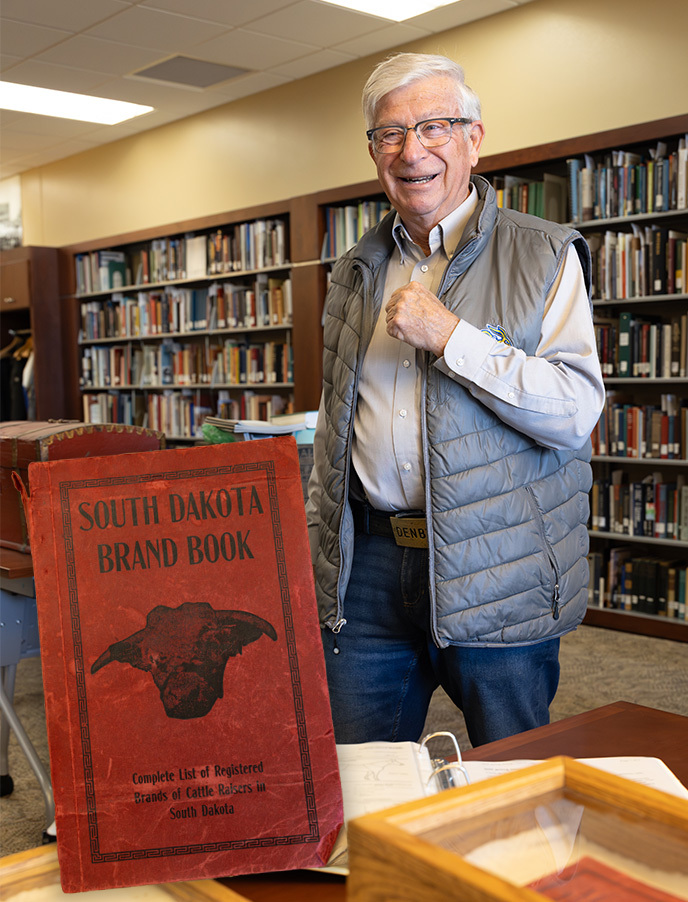
Best brand book collection in South Dakota — Bar none
In fall 2025, the library received a collection of South Dakota livestock brand books from Myron Sonne, a retired ag educator and an SDSU grad. Among them is an 1883 volume issued by the Western South Dakota Stock Growers Association. The hardcover booklet was designed so it could fit in the brand inspector’s shirt pocket.
Alongside the association’s first-ever issued publication, which Sonne '67/M.Ed. '70 stored in wooden display boxes, is the first statewide brand book, issued in 1898. While slim, it was big enough that it would have had to travel in a saddle bag. Both books were compiled by F.M. Stewart, president of the State Brand and Mark Committee.
Sonne donated the 70-plus books after collecting them for almost two decades. He said he plans to continue pursuing his hobby, so the archives’ collection may grow.
‘Burbank of the Plains’
Another of the library’s paper collections is those of N.E. Hansen, a pioneering horticulturist and plant breeder who is often referred to as the “Burbank of the Plains.” Hansen made several trips to Siberia, Russia, China and Korea to bring back seeds suitable for the Northern Great Plains. Foremost among the species is Cossack alfalfa, which was transformative for prairie farming.
The accompanying photo shows a plant card issued by Russian authorities on March 31, 1924, for the transport of spirea chamaedryfolia, which is a woody flowering shrub.
The plant specimens were found in the attic of Old Horticulture, the 1901 campus building where some of Hansen’s materials had been stored. Eventually, SDSU forester John Ball gave the specimens to the archives.
The card states, “Museum of the Society for Manchurian Studies, Department of Natural History and Regional Botany, Manchurian Herbarium of Flora. Where collected: Mountain ridge of Zhang Guang Cai Ling, in a forest cabin of Shitouhezi. Chinese Eastern Railway. On the mountain ridges (illegible). In a deciduous forest.”


Dakota Tawaxitku Kin or The Dakota Friend
The Dakota Friend was a monthly publication written in both Santee Dakota and English, making it one of the first Dakota language publications. Begun in November 1850, the Dakota Mission publication lasted 20 issues. The newspaper ended with August 1852 Vol. 2, No. 8.
Printed in St. Paul, Minnesota, editor Gideon Pond came to Minnesota with his brother, Samuel, to work as missionaries. The brothers helped to produce a written Dakota language alphabet and assembled the first Dakota-English dictionary. According to the publication’s mission statement, the newspaper aimed to share stories of interest to encourage reading among the Dakota people. It included local news, sports, language lessons and treaty transcripts.
Acquired in 2017, the archives preserves this significant example of early Dakota language publishing.
Let there be Hope
"Hope" is the name of a wheat variety bred by 1918 SDSU graduate Edgar McFadden that is credited for helping to feed the world during an era when stem rust would wipe out seemingly bountiful crops just before harvest.
Working through Kevin Kephart, the former SDSU vice president for research and economic development, a few years ago, the McFadden family donated the researcher’s field notebooks used to collect data and observations.
In addition to the field notebooks, there was the registration certificate for “improved cereal varieties — Hope, bred by Edgar S. McFadden, Webster, S. Dak.” and dated Sept. 2, 1926. The following year, it was released for commercial sale.
The landmark rust-resistant wheat variety had a major impact not only in the United States but around the world. McFadden's work helped strengthen global food supplies, and he is credited with saving millions of lives.

First Native American in Congress
The library also houses an extensive collection of papers from Ben Reifel documenting his life and career in the U.S. House of Representatives and with the Bureau of Indian Affairs.
A 1932 agriculture graduate, Reifel became the first Lakota Sioux to be elected to Congress when the Republican was chosen to represent South Dakota’s First District in 1960. He served five terms and did not seek re-election in 1970.
Born in a log cabin in 1906 on the Rosebud Reservation to a German-American father and a Lakota Sioux mother, he was given the Lakota name Lone Feather. He worked for the Bureau of Indian Affairs from 1933 to 1949. After earning his master’s and doctoral degrees in public administration in 1950 and 1952, respectively, he returned to the BIA before resigning to run for Congress.
A historic American flag
Enclosed in a glass frame and mounted on a wall in the Daschle Room, home of the Sen. Thomas A. Daschle Congressional Research Study at Briggs Library, is the American flag that flew over the U.S. Capitol on Sept. 11, 2001.
Written by Dave Graves, University Marketing & Communications

Explore More STATE Magazine
From inspiring stories to campus highlights, there’s more waiting for you. Visit STATE Magazine to read more features like this one, stay connected, and share your news with the Jackrabbit community.
Visit STATE Magazine